Knitwear retains its appeal across a wide variety of consumer demand sectors: from haute couture to sportswear, and from luxury underwear to corporate clothing. However, Russian manufacturers of knitted garments and fabrics, who had demonstrated a powerful surge since 2022 in both production volumes, quality, and assortment, have somewhat slowed down their pace this current year. The same cannot be said for foreign competitors, who are actively increasing import volumes into Russia.
According to Rosstat data, the production volumes of knitted clothing in Russia in January–September of this year decreased compared to the same period in 2025. Russian factories supplied consumers with 197.2 million knitted items, which is 94.4% of the previous period. This might seem like a decent figure, but it is unlikely to secure an annual total comparable to the 2025 volume of 276.9 million pieces! Figures are declining across the entire assortment: down to 86.2% for outerwear, 98.5% for underwear, and 91.1% in the sportswear sector. By the end of September, the output of knitted and hosiery fabrics reached 35.8 thousand tons, representing only 88.1% of the level of the corresponding period in 2025.
The reasons for the decline in volumes are well known: a drop in consumer demand, increasingly complex logistics for raw materials and technological components, and issues with marketplaces. However, "slumping" today by no means implies bouncing back tomorrow under the pressure of foreign competitors and rapidly changing market realities.
The past "Interfabric.Autumn-2026" exhibition demonstrated just how interested foreign knitwear manufacturers, primarily Turkish ones, are in the Russian market. International holdings with Turkish participation are offering Russian consumers innovative novelties in yarn and knitting processes. Turkish companies are actively investing in knitting factories in Ivanovo and other regions. Domestic factories are searching for their own identity in the dynamically developing knitwear market, but here it is crucial not to miss the right moment and to retain the sectors already mastered: the effect of 2022, when Russian knitwear jumped by 37.2% against the backdrop of departing Western brands, has now completely worn off.
Meanwhile, Turkish colleagues continue to strengthen their position on the Russian market, offering both a wide range of ready-made products and contract manufacturing at their own factories for fabrics of any structure and color based on the orders of Russian designers.
For instance, Saka Tekstil, which has representative offices and warehouses in Moscow and Ivanovo, also manufactures fabrics to individual orders in modernly equipped facilities in Elazığ, eastern Turkey. In Russia, Saka Tekstil focuses on supplying casual and street-style clothing, given the Russian consumer's long-standing familiarity with Western brands on the level of ZARA and Bershka. Having received European certificates confirming compliance with high standards, the company produces textiles for various purposes, including children's wear.
At the "Interfabric" exhibition, Saka Tekstil actively showcased a new type of knitwear – scuba. This is a dense, resilient, and smooth knitted material with a neoprene effect that creates clean shapes and voluminous folds. The name comes from the English abbreviation SCUBA (self-contained underwater breathing apparatus), as the porous rubber base was originally used for wetsuits. The technology makes it possible to create a fabric that looks identical on both sides. Yet one side is cotton, providing good tactile properties, while the other is viscose or polyester. T-shirts, tracksuits, and jackets made of scuba are pleasant and practical to wear, and are especially convenient for sewing, as such fabrics do not fray at the edges like regular fleece (footer).
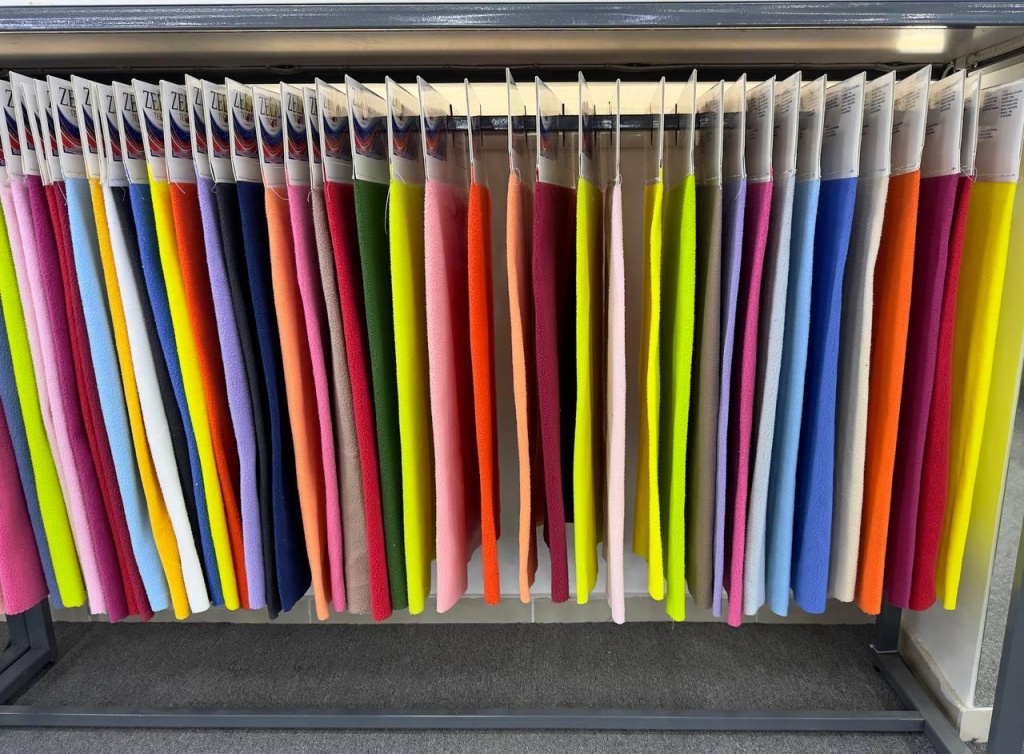
Uzbekistan’s knitwear producers are keeping pace with Turkish companies. Zelal Tekstil, founded in 2006 in Tashkent, currently produces 70 tons of knitted fabric daily. Its production complex, covering an area of 124,000 square meters, is equipped with advanced machinery for producing and finishing knitted fabrics. Zelal Tekstil's assortment includes the most in-demand types of knitwear made from cotton, viscose, and wool. The company produces single jersey, interlock, pique, velour, 2-thread and 3-thread footer, as well as rib knit and cashgora.
The factory's management identifies active exhibition activity as one of its strategic tasks. Zelal Tekstil is a regular exhibitor at Russia's "Interfabric" as well as at textile exhibitions in Turkey, Germany, and the UAE. This allows Zelal Tekstil not only to promote its products but also to demonstrate the modern level of the Uzbek industry.
In the battle for customer attention, Russian manufacturers are seeking new niches where they demonstrate a high level of quality and an innovative approach to production details and the products themselves. For example, the KS Knitwear Factory, a new participant in "Interfabric" from Elektrostal, Moscow Region, is developing a signature specialization: the production of ribbings, cuffs, polo collars, tapes, cords, knitted fabrics, side stripes (lampas), elastic bands, and other components of fashionable and high-quality knitwear. Among the factory's clients are well-known brands such as 12 Storeez, First inSpace, and DIVNO.
Today, KS produces over 15,000 items per month (starting from just 1,500). Special attention is paid to customization—choosing color, texture, and sizes per client request, as well as a rich palette of more than 100 shades. Modern equipment makes it possible to create seamless knitted parts with unique patterned weaves and any design.
Russia's knitwear sub-sector is fully capable of competing with the best foreign factories in terms of quality and assortment. As for volumes, the potential is undoubtedly there. Whether it will be successfully utilized will be shown by the spring ITF (Interfabric) exhibition, which will sum up the results of the outgoing year.


